Art and Architecture of the Babylonians, Sumerians, Hittites, Greeks, Romans and Sassanians
Streaming unavailable pending 2021 innovations
Reviews 'Outstandingly successful, in supreme command of its material. Reliable and precise, it is, at the same time, light and elegant, particularly penetrating in the shots of early portrayals of mankind. It transmits a wealth of knowledge. The greatest moments are the interpretations of the history of civilization in conjunction with individual sculptural, architectural and scenic objects.' German Center for Film Classification
Awards Gold Ribbon, Berlin
Credits Director/Narration: H J Hossfeld
40AB
55 minutes Color
12 to Adult
Adobe Flash Required. See more
48hr Streaming Access
Loading the player...
The Ziggurat of Marduk, the Tower of Babel we read of in the Bible, is today nothing more than a heap of mud bricks. Robert Koldewcy directed the excavations here until 1917. A water-filled ditch surrounds the monument; it once contained the mantel of the tower, built of baked bricks set in asphalt. Now little remains, it was used as a quarry for centuries.
An excavation on the site in 1962 tried to find an exact dating of the mound itself, the core of the structure, the answer to a still unsolved question. Koldewey was the first in Mesopotamia to measure architecture to the millimeter and to draw reliable plans. But even so he did not go beyond separating the nucleus of clay and the outer wall of brick and had neither the means nor the method to examine the mud bricks themselves. It was not until later that his students and successors, Walther Andrae and Julius Jordan, developed a suitable technique of excavation for mud brick architecture.
Since then even the workmen have learned this technique and after many years of training they are able to find the layers of stretchers and headers: recovering the different tones of color and with the cutter feel the varying consistency of the material, they know how to skeletonize right down to a single brick.
Beneath the debris of later centuries we can make out the level reached by Alexander the Great when he pulled down the Ziggurat with the intention of building it anew. However painstaking the work with mud bricks, the internal structure of so frail and perishable a fabric can only temporarily be shown. Only the most accurate measuring and drawing, done to the last detail, can complete the revival of the past. Even today dry mud bricks are the usual building material in great parts of Africa and the Near East. Stone and wood are scarce, firewood for the brick kilns rare and expensive. So the moistened clay, shaped in boxes, is simply dried in the sun.
From the earliest ages, the Euphrates with its dead arms flooded in springtime and boggy the year round with its ditches dug by successive peoples and races, has been the principal source of Life. Irrigation works were as large and important in prehistoric as in later times but more recently because of political happenings, a natural shifting of the river bed, the irrigation works near Uruk as elsewhere went to ruin: Warka today lies in almost complete desert.
This is an archaeological landscape and a most typical one. It is difficult to distinguish the excavators spoil banks from the ancient ruins themselves. In 1854 Loftus, an Englishman, was the first to discover the site. From the then hardly visible traces of Gilgamesh famous walls he drew the first plan of the city.
Dwelling and burial mounds, deeply cut through by trial trenches: and this an artificial handmade cone, perhaps an observatory, the Ziggurat's huge stump; this is where one of the first highly developed civilizations grew, the state of Sumer. From the archaic levels of the Eanna sanctuary to the temple of Parthian times, some 4000 years of continuous history lie hidden beneath the sand.
The excavations started in 1913. Here the archaeologists Jordan, Noldecke, Heinrich and Lenzen, the last named is the director of the archeological operation today, developed the technique of skeletonizing. They learned to uncover large areas, to dig deeply beneath the surface and till now have discovered eighteen different strata.
The desert's dawn and sunset make Uruk appear a site of high towering ruins; in reality it consists of narrow walls, often only a few brick layers above the foundations. Whenever old structures crumbled or were demolished, the sites were cleared with religious ceremony and new buildings erected on higher levels. From the dawn of prehistoric times until the comparatively recent history of the Parthian occupation this sequence was repeated again and again, leaving layer upon layer of different levels at different periods. Investigation has to rely on differentiation. The varying dimension of the brick tiles are one of the starting points. It is a sort of analytical archaeology and as in postmortem findings has to be clearly documented to the last detail. Only when work is done, can the excavator begin to list his findings.
What are the findings of this expedition? They show a building which resembles a double apsed cathedral, manifold and imposing, a monument creatively shaped. Niches accentuate the walls of mud brick in a rhythmic pattern probably of religious significance. The builders usually used the simple dried mud brick, but also material of comparatively high value in this country: limestone and marble set in asphalt, a concrete of gypsum and ground bricks, still bearing the marks of the reed mattings that were pressed against them.
Finally the cone mosaics, the Sumerians very own invention: a means to give accent, color and additional strength to the brittle clay fabric of the walls, columns and pilasters; little cones of stone or baked clay set in plaster concrete or simply inserted in the wall. The patterns, lozenge, zigzag, simple diagonal designs, are reminiscent of plait work. The different tones, some red, some black and some of brighter colors, today faded, must once have contrasted brilliantly.
Against this model in the Iraqi-Museum in Baghdad here is a large marble vase. Those artists and craftsmen of five thousand years ago! What problems of material, form and color did pester them. The results remain for all times. Cattle, the wealth of the ancients, attacked by lions: one of the ever returning subjects in visual art: The threat to life against guarantee of life. Who guards the flocks? Hunter? Hero? Ruler? Goti man? Clod himself? Gilgamesh? Tammuz?
Here is a stele, with a relief carving: the first and earliest of a long series representing the struggle of man against beast. It has been called rightly the first monument to tell history. It is wrought in basalt, the hardest of stones, but the artist lived in the plain of river slime and desert sand.
Sacrificial cattle would be driven up the ramps to the terrace of Anu, God of heaven, where his temple stands. We can now reconstruct fairly exactly the essential features of this building: it was one of the first Mesopotamian Pyramid temples. The god, far away in the heavens, is worshipped by a deeply believing people, who sacrifice and pray for help.
A large alabaster vase shows a ritual procession in honor of Innin Ishtar, the great mother goddess, incarnation of fertility. The entire concepts of nature developed by the people of Sumer are manifest in this monument. The organization of nature and society progresses from flora and fauna, to man who is related to the god by worship and sacrifice, and finally to the priest whose intricate symbols and gestures defy explanation.
Out of the water, the source and origin of life, grow the crops of the fields followed by cattle and sheep, and lastly comes man, the worshipper, his image is destroyed but is easy to reconstruct from many analogies. Ahead of him goes the ruler and hero, the god man, mediator between two worlds: his servant with offerings in front, the train bearer behind. He advances toward a deity, or perhaps its representative, the priestess? We do not know.
The most recent find from Warka shows us the effigy of the city ruler, the ruler priest portrait true to full life. This is one of the world's oldest images of man to be discovered Teel Halaaf until now. Since Max Baron of Oppenheim excavated the Teel Halaaf, we have come to recognize these grotesque idols as the expression of fertility symbolism that was so vivid throughout the ages in the Ancient Orient. These particular ones, now in the National Museum of Damascus, were found by Anton Moortgat in Tell Chuera near Syria's northern frontier.
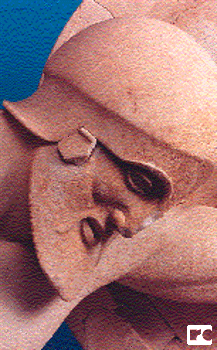
This little female torso from Warka: hardly shaped, hardly real art, the idol strikes one as quite modern in form. Everything in it speaks of earthbound heaviness, instinctive motherhood, complete femininity. And like that earlier masterpiece, this face of the woman from Uruk, where all delicacy and sensibility is incorporated yet barely rendered, concealed rather beneath a tender harshness. An everlasting message of humanity.
The face of man, shown already to perfection 3000 B.C. in Summer of Mesopotamia, where today Iraq is.
"I am Tabarna, the great king, and I ruled over Hattusas. In those days he set out, and like a lion the Great King crossed the river Puran, and like a lion with his fore paw he overcame the city of Chachu. And he piled dust upon the city, and with its riches he filled the stores of Hattusas
Then I set out against Chachu, and three times I assaulted the gate and I ravaged the town. And their goods and chattels I brought to Hattusas, my capital. Nobody had ever crossed the Euphrates. Tabarna, the Great King, crossed the river on foot, and behind him his armies crossed the river on foot. When Tabarna, the Great King, defeated the king of Chachu, he set fire to the cities, and he offered the smoke to the sun god in the heavens, and the smoke was his sacrifice to the weather god. "And I harnessed the king of Chachu to my car."
What we see today of the royal capital of the Hittites is a wide rock strewn hill set in almost primeval scenery. The mastering of this area, isolated in the middle of the Anatolian plateau, is a clear indication of the political strength of the Hittite empire dated from the 17th to the 13th century B.C. When the town was flourishing about 4 miles of towered walls surrounded a dwelling area for about 20,000 people. In between there are citadels and temples with their cyclopean square foundations of great stone works and lastly, in a dominating position above the precipice, the royal stronghold.
It is not easy to distinguish between what was shaped by man and what by nature herself. Rocks and masonry join together and form a gigantic fortification which carefully exploits the contours of the terrain. The name of modern Boghazkoy, a little village, refers to a deep gorge in the vicinity. It is above this gorge that Buyukkale rises, the mountain on which the fortress stands.
The main feature of the royal castle, which was at the same time the citadel and the nucleus of the city, can be reconstructed from the remains. A fragment of a bowl suggests the general aspect of the fortifications, how the battlements and towers would have looked. The walls of mud-bricks were strengthened by beams and were a sort of timberframe architecture, rising on rubble walls.
In the fourteenth century B.C. when building activity was at its peak, Hattusas covered a greater area than at any other time: a hundred and fifty years later the whole city was destroyed by fire. A great and long lasting fire which reduced the dry, mud bricks to powder or turned them into clinker. The Barbarian Invasions from the Balkans and the Aegean extinguished the Hittite empire in Anatolia and dark and silent ages were to follow.
Within the fortification walls five temples have been excavated up till now. The largest lies in the lower city: the temple of the weather god of Hattusas. In the same large area we find the storerooms and magazines of the temple domain surrounding the temple itself. Foundations built of monolithic blocks, some of them carefully smoothed, some rough faced which don't naturally harmonize with the timber frame work built above. The asymmetry of the design, in which features of the terrain clash with form and pattern: all this is characteristic of Hittite architecture.
But the royal stronghold, not the temple, is the heart of the town. It is the basic difference between this and other capitals of that time. A mile out of the city across the deep gorge lies Yazili-kaya, which is a modern Turkish name and means "inscribed rocks".
And this too is typical: architecture and nature, here a ravine, combine to form a sanctuary. The walls have been carved in relief, representing the gods of the Hittites and their myths. In 1834 the French traveler Texier saw these strange pictures for the first time. Not until much later did research succeed in deciphering the hieroglyphs, partly by comparison with texts on clay tablets.
One of these Yazilikaya-texts reads as follows: At New Year a glorious festival of heaven and earth was celebrated in honor of the weather god. All the gods assembled and entered the house of the weather god. Now eat and drink at this festival! Satisfy thy hunger! Quench thy thirst! To king and queen give thine praise! To heaven and earth thine praise! To the crops of the fields thy cheers!
The gods walk along the walls in solemn procession according to the strict rules of ceremony in gesture and dress. They are 'the thousand gods of the realm of Hatti', sworn by and called to witness when treaties were concluded or oaths pronounced. To the left the gods, with pointed hats and doublets, to the right the goddesses with a sort of top hat and trailing robes, they approach the main scene on the central panel: here the weather god meets the great goddess Hepat, who leads the procession of the goddesses and is followed by her son, Sharruma. The main gods don't stand on the ground but, according to their rank and importance, on lions, double-headed eagles, on mountain peaks or even on the humbly bent neck of a deity of inferior rank. The Pantheon of the Hittites allows many gods of many peoples. Religious tolerance and political skill go hand in hand.
At the end of the procession comes the Hittite king, portrayed as a founder: the hieroglyphic signs above his outstretched hand give us his name: "His Majesty Tudhaliyas, emperor and great king".
For several decades Boghazkoy has been entrusted to German excavators by the Turkish government; Makridy Bey from the Istanbul Museum and Hugo Winkler started the first expedition in 1906. From the very beginning the results were sensational. From the inscribed tablets found by Winkler beneath the debris left by the fire, resurged the history and life of a great people, till that time scarcely heard of.
Later work, from 1931 till now directed by Kurt Bittel, resulted in a thorough investigation of the site: modern methods of stratification were systematically applied and no detail, not even the least potsherd escapes documentation and careful consideration. Besides the architectural features, it is the number of inscriptions that renders Boghazkoy particularly important. Up till now more than 20,000 clay tablets or fragments of such tablets have been found. The Turkish workmen recognize at once the value of such a finding: Yazili: a stone with an inscription! It means a reward of 100 kurush for them.
The archaeologist discriminates on the spot between the different kinds of texts: laws, treaties, funeral rites, diplomatic correspondence. The Hittites took over the writing in cuneiform character from the Sumero Babylonian civilization, but adapted it to their own 25 Indo-European language, for use in affairs of state, religion and diplomacy.
The arrowhead character represent syllables: transcribing them into Latin script is the first stage in the process of reading and translating. If a bondsman sets fire to the house and the lord compensates for the damage, the slave's nose and ears are cut off and then he is to be handed back to his lord. But if the lord will not make compensation, then he must cast off the slave concerned.
Since Friedrich Hrozny published his results in 1915 we understand the Hittite language. But it was not until 40 years later that scholars could decipher the Hittite hieroglyphs, a hieratic picture writing found on rock cut reliefs or on seals. - The second stage of the process is to make a copy with the aid of both original and transcription.
A great deal of philological research done by Ehelolf, Friedrich, Gotze, Offen and others, sheds light on the various aspects, social, juridical and political of the life of the Hittites.
The characters were cut into the wet clay with an engraving in pencil. After that the tablet would be dried in the sun or baked. Immense collections of such tablets, entire libraries, often even with a catalogue, have been found preserved in the top layer of the debris. But they are damaged and sometimes badly weather beaten and only the handwritten copy is the real starting-point for further research "deported slaves, whom the father of my son brought back to Hattusas .... If now a man runs away, but you, Manapadatta, will not bring back the man. And this too shall be said under oath.
After Egypt and Assur-Babylon the Hittites represent the third Major Power of the Ancient Orient. This political standing was achieved not only by successful wars but by ingenious treaties and a masterly handling of foreign affairs. For the first time in history there is an entirely modern touch in politics.
Many features of their monuments show this absolute mastery and imperial power. The minor arts on the other hand make a charming contrast to this. Look for instance at this golden goddess, rendered in a playfully naturalistic manner or at this mountain god, the mountain formally represented, carved in ivory, with folded hands and a horned cap.
Lion, griffon and sphinx on an ivory disc, an elaborate miniature of high artistic value. The modeling of animals in jewelry and on seals.
Findings from a city which was thoroughly pillaged and devastated. These are only a few examples of a manifold craft, which in its invention and shaping, appeals at once to modern understanding and artistic taste. Here lay Hattusas, capital of the Hittite empire in the second millennium B.C. About 100 miles eastward from today's Ancara, situated in primeval scenery, the somber and severe highland of Anatolia, the heart of modern Turkey.
This group was found in a post Hittite level of Buyukkale, the citadel of Boghazkoy: a statue of Cybele, the Phrygian mother goddess, accompanied by two little attendants, playing the double flute and the cithara. The Anatolian great mother has the archaic smile of early Greek art.
This statue of Artemis was made 500 years later under the Roman Empire. The lavish image, of lustrous white marble was found by the Austrian expedition in Ephesus. The face is modeled in the classical Greek tradition yet shows a veiled rigidness, a non-Greek strictness. Headdress and robe are covered with representations of animals: symbols of growth and life. The Great Diana of the Ephesians, the mistress of animals, the nature goddess, sister of Innin Istar, of Anahita and Astarte.
Asia Minor is the geographical link between East and West; here the Aegean invaders made halt; great conquerors forced their way through its highways, different civilizations met at the trading posts and in the cities. Besides Ephesus, where Austrian archaeologists are at work, there are famous and widely known sites connected with German archaeological tradition. One of the latest discoveries, in 1957, was that of the Panionion, the religious center of the Ionian confederation, situated at the base of Mount Mycale, opposite the island of Samos.
After many centuries the Meander came to a vast alluvial transforming that part of the Mediterranean into a marshy delta. Cities, in which life cannot be imagined without ports of easy access, were cut off and are ruins now. Myus, Magnesia on the Meander, Priene and Miletus, Heraclea on the Latmus, Euromos and Didyma, these cities with their temples, theatres, baths, gymnasiums and market places, marked with an asterisk in the international guide books, are all chapters in the history of archaeology.
Wilderness: reverting to earth, a scene of melancholy and bucolic romance. It was mainly Hellenistic and Roman architecture that was uncovered by Carl Humann and Theodor Wiegand, in the last two decades of the 19th and the first of the 20th century. Continuing Ionian tradition they represent a late maturity, a richness and fulfilment, an exuberant climax which can only be followed by decline.
Every detail of the column bases, of the ornamental friezes, the fluting of the columns, reveal logical calculation, amazing chisel work and stylistic perfection. Excavations in Pergamum, resumed after world war II in 1955 aimed at deeper levels beneath the foundations of Roman times. Erich Boehringer and his staff dug trial trenches in the sanctuary of Zeus Asclepius. Like Weickert and Kleiner in Miletus, Boehringer searched for the primitive roots of the sanctuary. Near the holy fountain, where the sick came for curing, Boehringer and his assistants came upon remains of those earlier states of the sanctuary, of which we know from literary sources.
Together with the discovery of Troy by Heinrich Schliemann, Pergamum produced the most remarkable results of German archaeological research in western Asia Minor. The names of Human, Conze, Dorpfeld, and Wiegand stand for many splendid discoveries that nobody can expect ever to be repeated.
Above the little Turkish town of Bergama there rises the terraced citadel, the theatre with its steep auditorium of 80 tiers, temples and royal palaces. About three fifths of the ancient city has been excavated. It is impossible that the remainder still conceals such precious works of art as the altar of Zeus which is now in the Pergamum Museum in Berlin; nevertheless finds are to be expected, of the Hellenistic civilization, of that epoch of history, when Greece, and the Orient met to augment our musee imaginaire.
The emblems of humanity in this bust of Alexander the Great from the Archaeological Museum in Istanbul was discovered in Pergamum. Alexander set out to destroy the Persian Empire, and died in Babylon, having built a new empire which he believed to incorporate the best of Greece and the best of the Orient.
Such is the beginning of a working day on the excavation site of the Takht-i-Sulaiman, a ruin from the great age of Persian history, the age of the Sasanian kings. An almost circular plateau, formed from the calcium deposit of the lake, is surrounded by a wall fortified by 38 turrets.
The water pours out at 22 gallons a second and down to the plain in two streams: in the hot and arid highland of Azerbaijan you find a bewildering paradise, green and fertile. A couple of miles away there rises the imposing cone of Zendan-i-Sulaiman which is not of volcanic origin but likewise comes from the lime deposits of a chalky spring, of which there are many in these parts.
On the upper part of the slope the German archaeologists uncovered the foundations of buildings which surrounded the whole of the peak and no doubt enclosed a sanctuary of mysterious elemental powers. Its origins are supposed to date from before the middle of the first millennium B.C. Some time or other due to volcanic action the water flowed away, leaving only the gully which was later popularly named Zendan-i-Sulaiman, "the prison of Salomo". Here, finds could well be made, which would lift the veil of mystery from this almost unique mountain sanctuary of ancient Iran.
Sulfurous gases and the steepness of the walls prevent any descent. In 1962 the expedition used modern mining techniques to drive a shaft into the base so as to reach the bed of what was once a lake. The Zendan-i-Sulaiman is equaled as a strange phenomenon by the Takht-i-Sulaiman, the "throne of Salomo", the history of which begins, as far as we know, a thousand years later.
In 1838, the Englishman Rawlinson described both sites for the first time. It was not until a hundred years later that the Americans Pope and Wilber made an archaeological survey of the extant ruins. And twenty years later Hans Henning von der Osten and Rudolf Naumann started the excavations in which Swedish and Iranian scientists took part.
The lofty ruins are the remains of the residential palace of Abaka Khan, one of the thirteenth century dynasty of mogul conquerors called II Khans. The separation of the early Islamic and Mongolian architecture from the earlier layers, and their respective dating, is the main task, set for the summer, which here, at a height of over 6,000 ft, is short. One of the characteristic features of an archaeological site is the pottery garden. Here the domestic architectural fragments are sorted out and receive their due treatment: location, level, material, color, ornament, form, comparisons of technique and style, all belong to the work of the archaeological detective. A shard found at a certain level can either corroborate or destroy a whole hypothesis; this is the solid ground on which all speculation of value must rest.
The fragments are cleaned, registered, documented, and set aside. With luck an entire vessel can be reconstructed. The important shards will be photographed or if they are particularly fine examples, like these glazed tiles of the mogul period in Iran, sketched as well. The Mogul palace rises above earlier Sasanian work which surrounded the lake with magnificent arcades and vaulted halls. The ruins of the great Liwan can be reconstructed from the example of the Sasanian crown residence at Ctesiphon near Baghdad, a vaulted open fronted hall. The walls were ornamented with painted stucco and draped with precious tapestries, the floors embellished with mosaics and carpets.
The oriental splendor and the magnificence of the scenery made Takht-i-Sulaiman one of the great legendary holy places of Iran dedicated to the magic of elemental powers, water and fire. It is conjectured that here, within the complicated maze of the fire-temple, is the very place where the holy fire was preserved. Legend says that it burned uninterruptedly for 700 years and never left any ashes. The fire altars figure on Sasanian coins. Originally guarded by priests, magicians, and built on mountain peaks and terraces in the high glens of the Persis, today the province of Fars, the heart of Ancient Persia.
The place of Persepolis largely resurrected by Ernst Herzfeld was, when originally built by Dareios and Xerxes, already a symbol of the empire which stretched from the Indus to the Nile, and from there to the Bosporus. The Sasanian kings called themselves the immediate heirs of the Achaemenids, who came from this very spot in the highlands of southern Iran. Not far from Persepolis, at Naksh-i-Rustam, below the rock tombs of Dareios the Great, of Xerxes and Artaxerxes, the Sasanian kings carved their exploits and triumphs on the sheer face of the cliff. The capture of the roman emperor Valerianus by Shapur I, after the battle of Edessa in 260 A.D., was a triumph worthy of Achaemenian tradition.
The king and his vassals: reminding one of medieval knighthood, but this scene is centuries older. Below on the plain the armed camp, tents with gay pennants, tournaments surging to and fro, the polo of the feudal lords, jousting, or hunting the boar and the lion. The godlike splendor of oriental kingship created legends around the last great Sasanian kings, which are still told today among Iranian people.
The knight in heavy armor, represented in the grotto at the Tak-i-Bustan is perhaps Chosroes 11 himself. He conquered Egypt, besieged the walls of Byzantium, took Damascus and Jerusalem and carried off the Holy Cross. In contemporary chronicles he is likewise hero and Antichrist. One of Chosroes legendary castles was the Takht-i-Sulaiman. That we can take for granted. Perhaps we can go even further: there exists a Sasanian bronze bowl, commonly called the throne of Chosroes. Its design reminds us of our monument and might be based on it. The lake, fathomless according to myth, is set in the buildings like a sapphire. This could be the source of the medieval concept of the Holy Grail: Twenty-two arcades enclose a magic center, in the medieval epic of king Titurel twenty-two choirs radiated from the Holy of Holies, the Grail.
"An old fairy-tale," says a chronicle of that time, "and yet, the very truth". In 628 A.D. Heraclius emperor of Byzantium defeated Chosroes at Ctesiphon and reconquered the Holy Cross. A few years later Caliph Omar and his Arabian hoarders defeated the Sasanian armies yet again and annihilated their cities. The last empire of the Ancient Orient comes to an end. New worlds were rising, Islam and the Occident.
Fully interactive transcript included with film purchase.
Remember to explore
included with your purchase.
Click image to activate Filmscape



 included with your purchase.